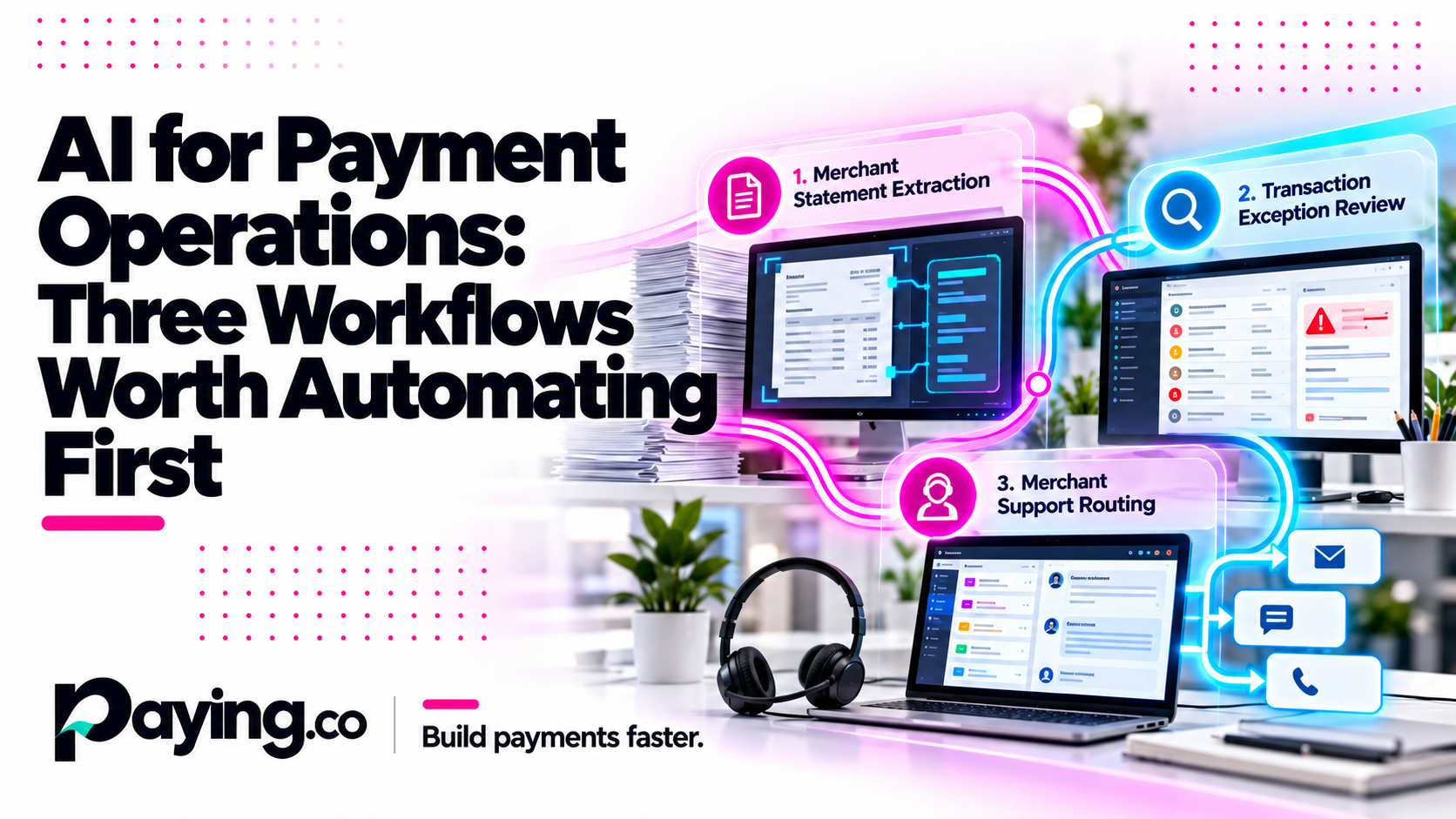
Start with workflows that are repetitive, text heavy, easy to check, and reversible: statement extraction, transaction exception review, and support triage. In each, let code do the deterministic work and let a model help with judgment calls, with a person reviewing anything that changes money or a customer outcome.
The examples below are fictional. This article makes no claims about ROI or fraud detection accuracy.
Workflow 1: statement extraction
A fictional example: a merchant services team receives monthly processor statements as PDFs and CSV files and re-keys fees into a spreadsheet.
| Aspect | Detail |
|---|---|
| Inputs | Processor statements as PDF or CSV |
| Outputs | Structured rows (date, fee type, amount, currency) and flags for fields it could not read |
| Human review | Every low-confidence field, plus a sample of the rest |
| Integrations | File storage, reconciliation or accounting tools, processor portal exports |
| Evaluation | Field-level accuracy on a hand-labeled sample, share routed to review, time to a reconciled month |
Workflow 2: transaction exception review
A fictional example: an operations analyst investigates transactions that fail to reconcile between the processor and the internal ledger.
| Aspect | Detail |
|---|---|
| Inputs | Unmatched transactions with processor and system records |
| Outputs | A ranked list with a suggested cause and next step, marked as a suggestion |
| Human review | Required before any adjustment or refund |
| Integrations | Reconciliation reports, ticketing, read-only ledger access |
| Evaluation | Share of suggested causes confirmed by reviewers, time to resolution, suggestions reviewers dismiss |
Workflow 3: support triage
A fictional example: a support team sorts merchant tickets about declined payments, settlement timing, and device issues.
| Aspect | Detail |
|---|---|
| Inputs | Merchant tickets and emails |
| Outputs | Category, urgency, suggested routing, and a drafted reply for review |
| Human review | People send all replies at first, and escalate disputes, security, and legal topics |
| Integrations | Ticketing system, knowledge base, read-only transaction lookup |
| Evaluation | Routing accuracy against agent corrections, reply edit rate, escalations missed |
Deterministic controls and model judgment
| Deterministic, enforced in code | Model judgment, always reviewable |
|---|---|
| Totals and schema validation | Reading messy or unstructured text |
| Amount limits and permission checks | Proposing a likely cause |
| Duplicate detection by transaction ID | Categorizing a ticket |
| Audit logging | Drafting wording for a person to edit |
The rule: model output never moves money on its own. Code enforces limits and a person approves anything that changes funds or customer outcomes.
Data, access, audit, and escalation
▸ Data minimization: send only the fields a task needs. Never send full card numbers, and mask personal data wherever possible.
▸ Access control: use least privilege, separate service accounts, and read-only access where it is enough.
▸ Audit trails: record inputs, outputs, model and version, reviewer, and decision for each item.
▸ Escalation: define when the system hands off to a person, and default to a person when confidence is low or the impact is high.
FAQs
Does this detect fraud?
This article does not make that claim. Fraud models need their own data, evaluation, and controls.
How should we start?
Pick one workflow and run it in shadow mode first: the model produces output, people decide as usual, and you compare the two.
Do we need to train our own model?
Not necessarily. Many workflows start with an existing model service. Choose based on data sensitivity, accuracy needs, and cost.
What should we measure?
Accuracy against labeled samples, the share routed to review, reviewer corrections, and time to resolution. Define targets before you start.
Next step
If you can share one workflow, the systems involved, and the data it touches, we can help scope a safe first pilot. Start at the artificial intelligence page.
Sources

Software executive with over three decades of experience. Focus primarily on the payment industry and FinTech technologies