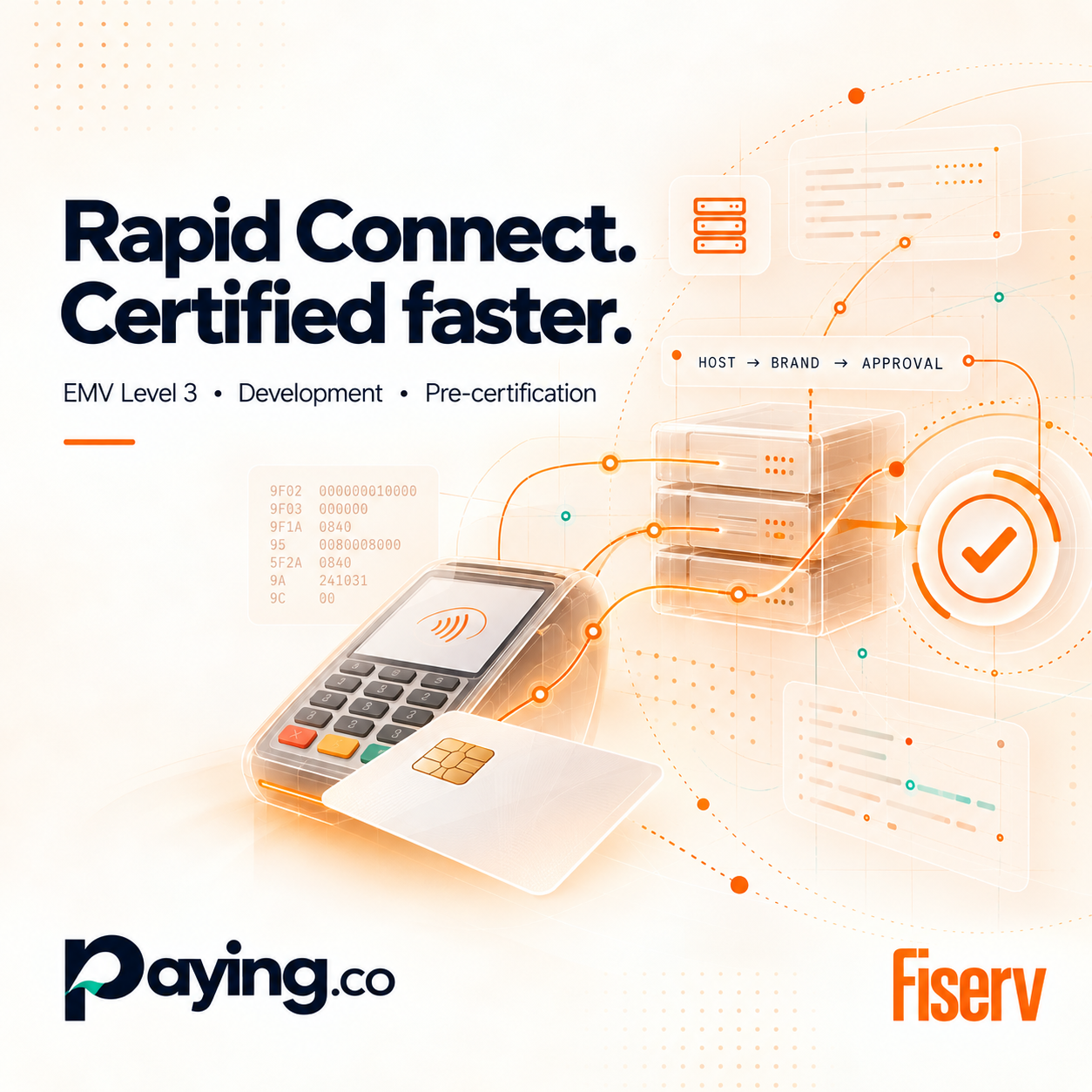
What RapidConnect actually is
RapidConnect (built by First Data, now under the Fiserv umbrella since the 2019 merger) is a single integration layer that sits in front of several Fiserv processing hosts. Instead of building separate connections to each back-end, developers integrate once against RapidConnect and authorize transactions through Fiserv's front-end hosts → North, Nashville, and Buypass → with settlement handled on the corresponding back-end. TransArmor covers point-to-point encryption and tokenization, and debit routing typically runs through Fiserv's own Star Network.
The pitch to ISVs and terminal manufacturers is straightforward: one interface, multiple hosts, less duplicated work. But "one interface" doesn't mean "no certification." EMV Level 3 still has to happen for each application and processor combination before a device can take a live card.
Where Level 3 fits in
Quick refresher on the layers, since they get conflated often:
Level 1 → the physical chip reader and electrical interface, usually owned by the hardware manufacturer.
Level 2 → the EMV kernel talking to the chip, typically pre-certified at the device level.
Level 3 → the full payment application, end to end, integrated with the specific processor and card brands. This is the layer that determines whether a terminal is actually approved for live traffic on RapidConnect, and it's where most projects lose months.
Examples across the platforms RapidConnect supports
Certification work on RapidConnect looks different depending on the device and use case:
PAX terminals → semi-integrated builds where the POS sends an amount and invoice number, and the terminal handles the EMV transaction directly against RapidConnect, returning only non-sensitive data like an approval code or token.
Ingenico devices → common on outdoor and unattended deployments (fuel, EV, kiosks) where host validation has to hold up against timeouts and reversals in a way indoor retail never tests for.
Clover-based builds → ISV-embedded payments where the certification has to account for a software platform layer sitting between the merchant and the terminal.
ID TECH readers → frequently the hardware layer in custom or semi-integrated builds where the L3 application is purpose-built rather than off-the-shelf.
Same host, same RapidConnect interface, four very different certification paths.
Why this is still slow, even with one interface
RapidConnect reduces integration complexity, not certification complexity. Every application still needs user acceptance testing, host validation against real transaction flows (reversals, settlement, timeouts), a full pre-certification pass, and card brand submission to Visa, Mastercard, Amex, and Discover. Skip the internal pre-cert step and findings surface for the first time during Fiserv's own review, which is exactly what turns a 6-month project into a 12-month one.
Where Paying.co fits in
This is the work we run end to end: EMV Level 3 Certification covers the full lifecycle from application build through card brand sign-off, using our own FIME, MV, and ICC tooling so testing doesn't queue behind a shared lab. For teams that want the process handled without any engineering hours pulled off their roadmap, Managed Certification runs the same process without ever touching the client's codebase → 70% faster timelines, 50% lower cost, 97% first-pass approval across 40+ certifications delivered.
If you're building on RapidConnect and staring down a certification calendar that doesn't match your launch date, let's talk it through.
EMV #EMVLevel3 #FiservRapidConnect #PaymentCertification #ISV #SoftPOS #PaymentEngineering #Fintech #UnattendedPayments #PCI #PayingCo

Software executive with over three decades of experience. Focus primarily on the payment industry and FinTech technologies


