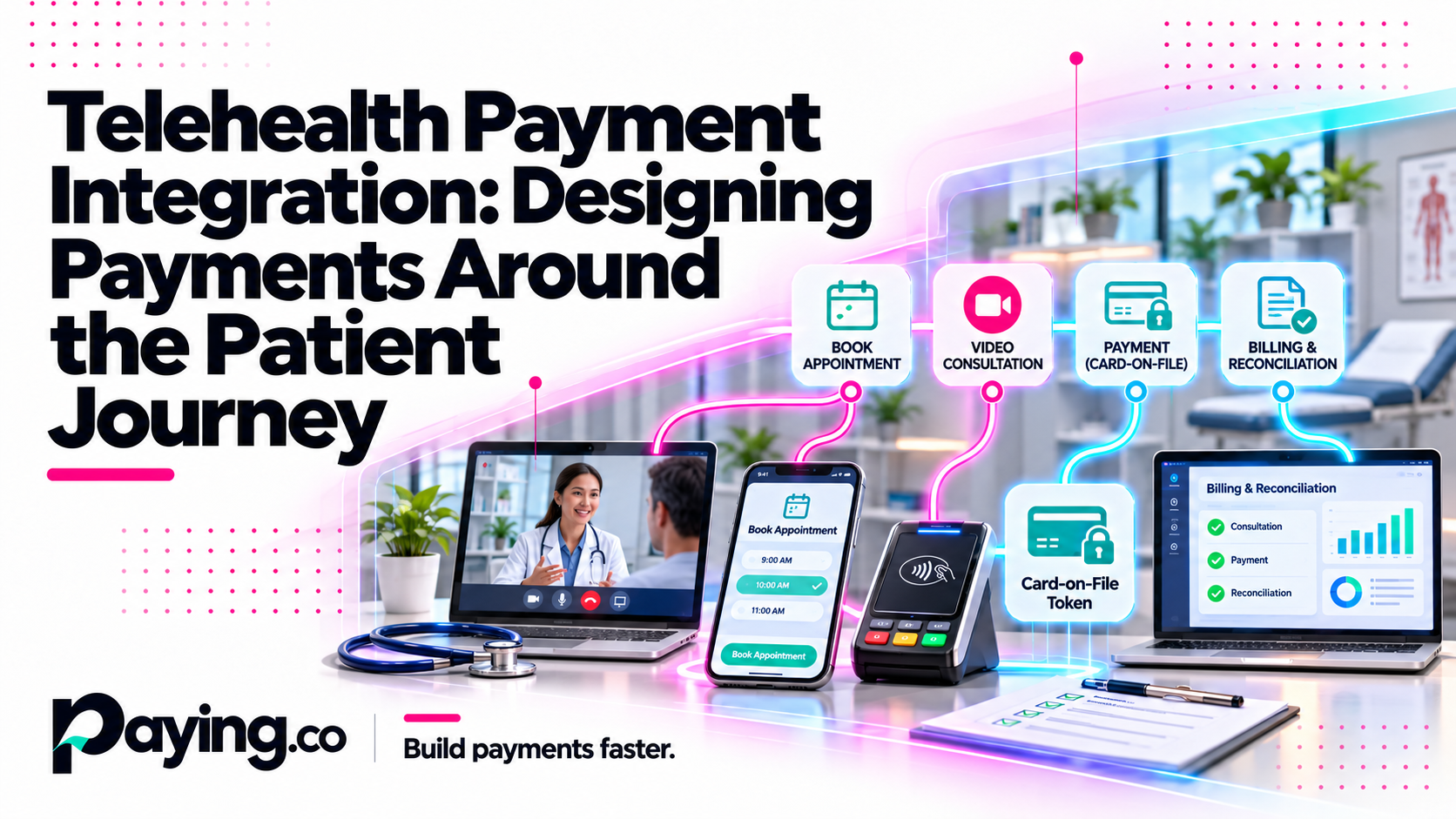
Most telehealth payment guides start and end with connecting a payment gateway. That is the easy part. The harder part is deciding where payment sits inside a virtual visit: when the patient is asked to pay, what happens when a card fails, and how every transaction is traced back to the appointment that caused it.
Paying.co treats telehealth payments as a workflow problem first and a gateway problem second. A telehealth platform moves a patient through a sequence of stages, and payment touches nearly every one of them:
Scheduling → eligibility → copay → consultation → additional services → follow-up → reconciliation
This article shows how to connect those stages without mixing clinical information, protected health information (PHI), and cardholder data in the same places.
Decide when to collect payment
There is no single right moment. Each option changes the patient experience, the no-show rate, and how failures are handled.
✦ At booking: Secures a payment method early and can reduce no-shows, but the final amount is often unknown until eligibility is confirmed. A stored payment method or an authorization hold usually fits better than a final charge.
✦ After eligibility: The copay is known and can be collected before the visit. For most insured visits this is the cleanest point.
✦ At check-in or just before the consultation: Works well for a copay, but a failed card now delays a clinician who is waiting. The platform needs a clear rule for what happens next.
✦ After the visit: Suits variable or add-on services, but collection gets harder once the patient has left the session. Pair it with card-on-file consent captured earlier.
Many platforms combine these: a payment method captured at booking, a copay at check-in, and a later charge for additional services.
Keep copays, self-pay, balances, and add-ons distinct
Four payment types often get treated as one. Keep them separate in the data model:
✦ Copay: a known amount tied to an insured visit.
✦ Self-pay: the full fee for a service with no insurance involved.
✦ Outstanding balance: an amount carried from a prior visit or billing adjustment.
✦ Additional service: a charge added during or after the consultation.
Each charge should carry its own reason and link to the appointment or service that created it. When a clinician adds a service mid-visit, create a new charge tied to that service instead of editing the original copay. Clean records make refunds and reconciliation far easier later.
Hosted payment pages or embedded payment fields
Hosted payment page: the patient pays on a page served by the payment provider. It has the smallest PCI footprint and is the fastest to launch, with less control over look and flow.
Embedded payment fields: the provider serves the card fields inside your own page. You get more control over the experience, and card data can still stay off your servers when the integration is built correctly. Your PCI responsibilities are usually larger than with a fully hosted page, and the right self-assessment depends on exactly how the fields are delivered, so confirm it with your assessor.
Choose based on how much control the patient experience needs and how much compliance work your team can carry.
Card-on-file and recurring care programs
Memberships, chronic care programs, and subscription plans depend on stored payment methods. Store a token, never a card number. Capture explicit consent and record what the patient agreed to: amount, timing, and cancellation terms. Plan for card expiry and replacement, and give patients a simple way to update or remove a card.
Tokenization and PCI boundaries
The telehealth platform should hold a token plus limited display data such as card brand, last four digits, and expiry. Card data should never reach the clinical database, application logs, support tickets, or chat transcripts.
The boundary runs the other way too. Keep PHI out of payment metadata. Send the processor an internal reference, not a diagnosis, visit reason, or provider note. Statement descriptors and invoice descriptions can be seen by processors and appear on cardholder statements, so keep them neutral.
Failed payments and the appointment workflow
A declined card is a workflow event, not just an error message. Decide in advance what each failure does:
✦ Does a declined copay hold the visit, cancel it, or let it proceed with a balance?
✦ How many retries are allowed, and by whom?
✦ Can the patient fix it in the same session with another card or a payment link?
Model these as explicit states, for example payment pending, payment failed, retry allowed, and visit proceeding with balance. Each one is a product decision that clinicians, front-desk staff, and finance should agree on before launch.
Refunds, cancellations, and no-shows
Write the policy before writing the code: the cancellation window, full versus partial refunds, and when a no-show fee applies. A no-show fee should only be charged when consent was captured at booking. Refunds should reference the original transaction. Release authorization holds that are no longer needed instead of leaving them to expire.
Payment links for remote follow-up
Payment links sent by text or email let patients settle a balance after the call without logging back in. Make each link single purpose, expiring, and tied to one specific balance. Keep PHI out of the URL and out of the message text.
Reconcile appointments, services, and transactions
Three sets of records must agree: the appointments and services delivered, the charges created, and the transactions and settlements reported by the processor. Put a shared internal reference on all three so finance can match them without guesswork. Then watch for the two failure patterns: money with no matching appointment, and services delivered with no payment or recorded balance.
HIPAA and PCI are separate responsibilities
PCI DSS governs cardholder data. HIPAA governs PHI. A single telehealth payment can involve both, but they are separate programs with separate obligations, and meeting one does not satisfy the other. Where a vendor may handle PHI, a business associate agreement may be needed, and your compliance counsel should decide that. Good architecture helps by limiting how much of each type of data any one system has to handle.
Where Paying.co fits
Paying.co is a payment-architecture and integration specialist. We work with healthcare platforms on how payments connect to the patient journey, from processor selection and tokenization boundaries to failure handling and reconciliation. We are not a general telehealth software development company, and that focus is the point.
Talk to Paying.co about integrating payments into an existing or new telehealth platform: paying.co/contact-us
Telehealth #HealthcarePayments #EmbeddedPayments #HealthTech #PaymentIntegration #PCICompliance

Software executive with over three decades of experience. Focus primarily on the payment industry and FinTech technologies