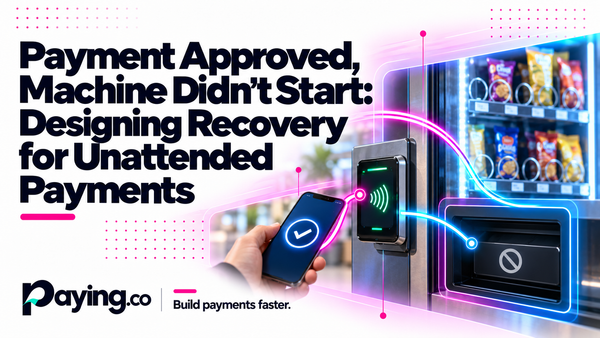
Payment Approved, Machine Didn't Start: Designing Recovery for Unattended Payments
Treat authorization, physical activation, and fulfillment confirmation as three separate events
Author
Sales development specialist
Treat authorization, physical activation, and fulfillment confirmation as three separate events
Start with workflows that are repetitive, text heavy, easy to check, and reversible:
Start by inventorying what the legacy app actually depends on, then replace it in slices instead of all at once.
Before development starts, settle which Simphony payment interface your integration will use, who supplies the payment service provider (PSP) side, and which parts of the flow you own.
Choose managed EMV certification when you already have a payment app or integration and need help getting it tested, documented, and approved.
Hire in-house when payments is your core product and you can fund a permanent team for the long term
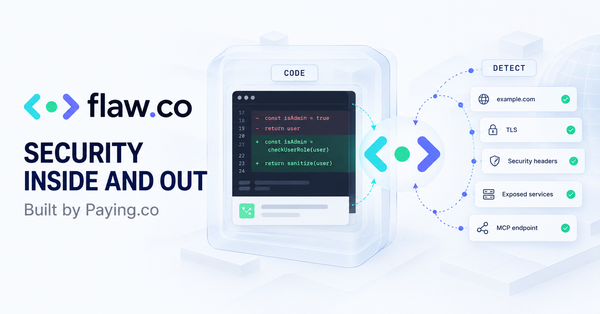
Code reviews what you're building from the inside. Detect examines what you're exposing from the outside.
Every chip-card transaction you have ever tapped or inserted passed through a piece of software you never see: the EMV kernel. EMV Level 2 certification is what proves that kernel works correctly and securely before a terminal is ever allowed near a live card.
Most payment systems don't fail dramatically. They erode. A processor integration written in 2014 still works, so nobody touches it. A magstripe fallback path that "we'll fix next quarter" becomes load-bearing.
Paying.co builds the rails. You build the company. Every SaaS platform, vertical software vendor, marketplace, and ISV eventually arrives at the same realization: payments are no longer a feature, they are the business.
If you're an ISO, VAR, agent, or merchant looking for the next obvious add-on to your payment processing book, here is the short version: unattended self-service is no longer a maybe.