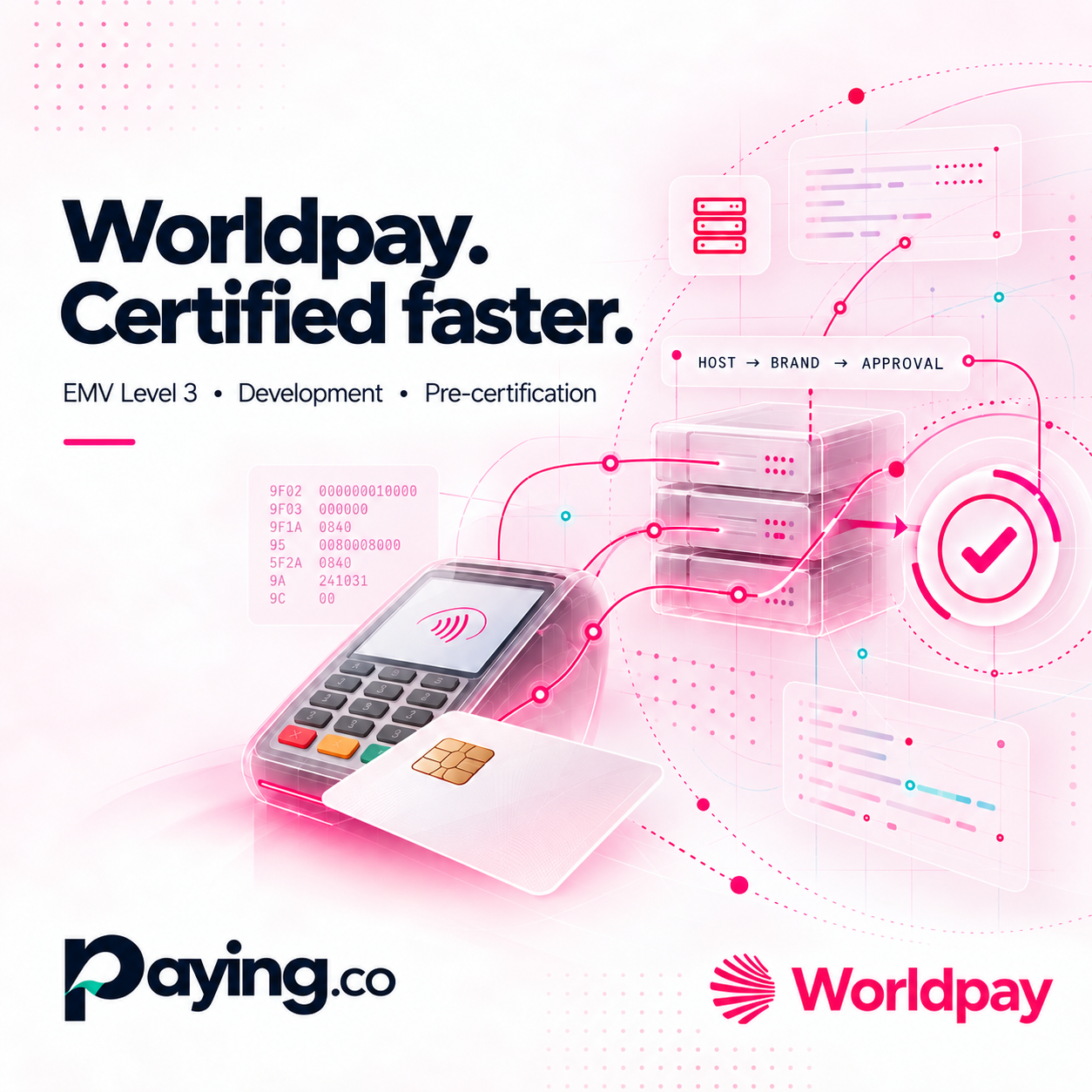
Worldpay. Certified faster. Same problem as always, different processor → get a payment application through Level 3 certification without it costing your team a year of engineering time.
Who Worldpay is today
Worldpay traces back through Vantiv, which merged with the original Worldpay Group in 2018 and took the Worldpay name. As of January 2026, Worldpay is owned by Global Payments, following its $24.25 billion acquisition from FIS and GTCR. The combined company now serves more than 6 million merchant locations and processes trillions in payment volume across 175+ countries, spanning everything from small business card-present retail to global enterprise omnichannel programs. For ISVs and terminal manufacturers, that scale is exactly why certifying against Worldpay's platforms still matters, regardless of which corporate name sits on the letterhead this year.
The platforms behind the certification
Worldpay isn't one integration, it's a family of platforms depending on how the merchant takes a card:
Worldpay Express (Integrated Payments) → the host-based processing platform most terminal and PIN pad certifications run through. This is the layer where triPOS sits, handling EMV, contactless, and encrypted track data for card-present transactions so the POS itself stays out of PCI scope.
Worldpay Total → an omnichannel, API-driven platform built to connect POS, mobile, and ecommerce under a single integration. It supports both a native IPC toolset for mobile app developers and a REST API for teams building against device-free or unsupported peripheral setups.
Express XML Web Interface / Express Direct → the specific communication layer terminal manufacturers certify against for card-present and card-not-present transaction types, tokenization, and partial approvals.
Same underlying acquirer, three different integration paths depending on whether you're certifying a physical terminal, a mobile SDK, or a hosted API.
Types of merchant processing Worldpay supports
This is part of why the platform choice matters for certification scope:
Card-present retail → the standard EMV chip, contactless, and swipe flows on a physical terminal or PIN pad.
Card-not-present / ecommerce → hosted or API-based transactions for online and mobile checkout, including recurring billing.
Unattended and semi-attended → kiosks, vending, fuel, parking, and self-service environments where there's no cashier completing the transaction, and the certification has to account for timeouts, reversals, and host connectivity that indoor retail never tests for.
That last category is where Paying.co spends a lot of its time. Unattended and semi-attended EMV builds carry certification requirements that a standard retail terminal cert doesn't touch, and getting it wrong shows up as a rejected submission months into a project, not a quick fix afterward.
Where Level 3 fits in
Level 1 → the physical chip reader and electrical interface, owned by the hardware manufacturer.
Level 2 → the EMV kernel talking to the chip, pre-certified at the device level.
Level 3 → the full payment application, integrated end to end with Worldpay's specific platform and the card brands. This is the layer that determines whether a terminal or app is approved for live transactions, and it's processor-specific → a Worldpay Express certification doesn't carry over to Worldpay Total, and vice versa.
Examples across device platforms
Certification against Worldpay looks different depending on the hardware:
PAX terminals → common in retail and unattended EMV builds running through Worldpay Express.
Ingenico devices → frequently certified for outdoor and self-service deployments, fuel and EV among them, where host validation has to survive real-world timeout and reversal conditions.
Clover-based builds → ISV-embedded payment flows layered on top of Worldpay's processing.
ID TECH readers → a common hardware layer for Express Payment Platform certifications, supporting EMV, contactless, and encrypted track across sale, pre-auth, completion, void, and return.
Verifone terminals → widely certified across Worldpay Express for both card-present retail and unattended deployments.
Sunmi devices → Android-based smart terminals frequently used in unattended retail and kiosk builds.
Miura readers → compact, Bluetooth and semi-integrated PIN pads common in mobile and semi-attended setups.
SoftPOS → tap-to-pay software running directly on a commercial smartphone or tablet, its own certification path since there's no dedicated payment hardware in the loop.
Where Paying.co fits in
We run this work end to end: EMV Level 3 Certification covers the full lifecycle, from application build through card brand sign-off, on our own FIME, MV, and ICC tooling so testing doesn't sit in a shared lab queue. For teams that want the process handled without pulling engineers off the roadmap, Managed Certification runs the same process without ever touching your codebase → 70% faster timelines, 50% lower cost, 97% first-pass approval across 40+ certifications delivered.
If you're certifying against Worldpay, attended or unattended, and the timeline doesn't match your launch date, let's talk it through.
Worldpay #GlobalPayments #EMV #EMVLevel3 #PaymentCertification #ISV #SoftPOS #TapToPay #Verifone #Sunmi #Miura #UnattendedPayments #PaymentEngineering #Fintech #PCI #PayingCo

Software executive with over three decades of experience. Focus primarily on the payment industry and FinTech technologies