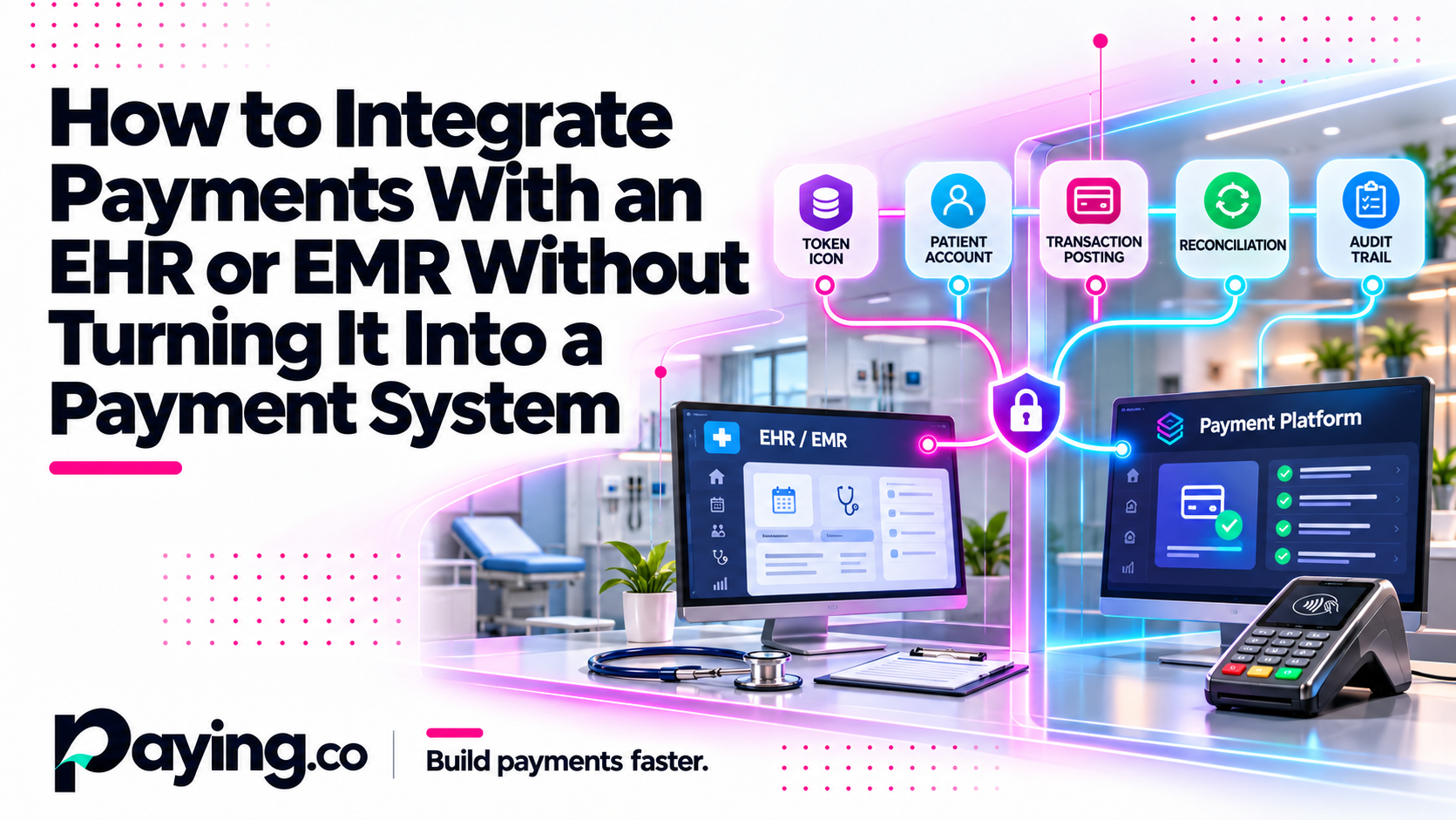
An EHR or EMR is the system of record for the patient. It knows who owes what, for which encounter, and what happened to the account. It was not built to be a payment system, and turning it into one adds risk, compliance scope, and maintenance burden that most healthcare teams do not need.
The cleaner model is a clear split. The EHR orchestrates the patient and billing workflow. The payment platform handles card data, tokenization, authorization, settlement, and processor communication. This article explains where that boundary belongs and why holding it reduces risk, PCI scope, and implementation complexity.
Orchestrate in the EHR, process in the payment platform
Think of the two systems as having different jobs:
EHR or EMR: patients, encounters, appointments, charges, balances, payment status, and the audit trail of who did what.
Payment platform: card capture, tokenization, authorization, capture, settlement, refunds at the processor, and all processor communication.
Every integration decision below comes back to keeping those jobs apart.
What belongs in the EHR or EMR
✦ Patient, guarantor, appointment, and encounter identifiers.
✦ Charges, adjustments, balances, and payment status.
✦ A payment platform transaction ID and an internal reference for every payment.
✦ A token or payment method reference, plus limited display data such as card brand and last four digits.
✦ The user who initiated each payment, refund, or correction, with timestamps.
What should stay in the payment platform
✦ Full card numbers and expiry dates. Security codes should never be stored after authorization.
✦ The token vault and the mapping between tokens and real card data.
✦ Processor credentials and routing configuration.
✦ Raw authorization, capture, and settlement data from processors.
✦ Fraud controls and authentication data.
If the EHR database, logs, or exports ever contain a full card number, the boundary has been breached and your PCI scope has grown with it.
Tokenization and stored payment methods
When a patient saves a card for later use, the payment platform returns a token. The EHR stores that token reference against the patient or guarantor, never the card. Record the consent that came with it: what the patient agreed to, when, and through which channel. Support replacement and removal, and decide who is allowed to charge a stored method and under what conditions.
Link every transaction to a patient, appointment, and encounter
Create an internal payment reference in the EHR before the payment starts, and pass it to the payment platform. When the transaction completes, store the platform's transaction ID back in the EHR. That two-way link lets staff trace a payment to an encounter and lets finance trace a settlement deposit back to a patient account. Use an opaque reference. Do not send diagnoses, visit reasons, or other clinical detail in payment metadata.
Post successful payments to the correct account
Post a payment only on a confirmed result from the payment platform, such as a verified server notification, and not because a browser returned to a success page. Make posting idempotent, so a repeated notification cannot post the same payment twice. Handle the case where someone other than the patient pays, such as a guarantor or family member, and make sure the payment lands on the right account.
Partial payments, payment plans, and patient financing
Plan terms belong in EHR billing: balance, schedule, and rules. Recurring execution belongs in the payment platform. Each installment should post as its own payment against a specific balance. Patient financing adds a third party, so decide early how approvals, funding timing, and remaining patient responsibility are recorded in the account.
Refunds, corrections, and voids
A transaction not yet settled can often be voided, while a settled one needs a refund. Either way, the EHR should record a new entry that references the original. Never edit or delete the original payment record. Require a reason, a user, and the right permission for every refund or correction.
Portals, kiosks, payment links, and card-present devices
Patient portal, front-desk kiosk, emailed payment link, and card-present terminal are different channels for the same event: a patient paying a balance. Design the integration so every channel produces the same confirmed payment event, and write the posting logic once. The same principle applies to pharmacy and practice-management systems that share patient identifiers and need to route charges to the right account.
Settlement and internal reconciliation
Processors typically settle in batches, often net of fees and adjustments. The EHR shows gross payments by patient. Reconcile at two levels: transaction level, where each EHR payment matches a processor transaction, and deposit level, where the batch total matches the bank deposit. Exceptions such as chargebacks and adjustments need a defined path back into the patient account.
Downtime, retries, and duplicate-submission protection
Networks fail at awkward moments. Plan for them:
✦ Use an idempotency key on every payment request so a retry cannot create a second charge.
✦ After a timeout, check the transaction status before retrying.
✦ If the EHR is unavailable when a payment completes, queue the posting and apply it once the system returns.
✦ Disable the pay button after the first click, and treat that as a convenience, not a safeguard.
Audit trails and role-based access
Record who viewed, initiated, refunded, or corrected a payment. Separate duties, so the person who posts payments is not the only person who can approve refunds. Limit access to stored payment methods and to payment platform administration, and review access regularly.
Why a clean separation pays off
A clear boundary keeps card data out of the clinical system, which narrows PCI scope. It makes the integration easier to build and test because each system has one job. It also keeps your options open: when the processor or payment platform changes, the EHR integration points stay mostly intact.
Where Paying.co fits
Paying.co understands both processor behavior and application architecture, including operational details that ordinary software integrators can overlook: settlement timing, reversal handling, retry safety, and how channels differ at the processor. We review integration designs before development starts, when changes are still inexpensive.
Have Paying.co assess an EHR, EMR, or practice-management payment integration before development begins: paying.co/contact-us
EHR #EMR #PatientPayments #HealthcareTechnology #PaymentEngineering #PCI #HealthcareBilling

Software executive with over three decades of experience. Focus primarily on the payment industry and FinTech technologies