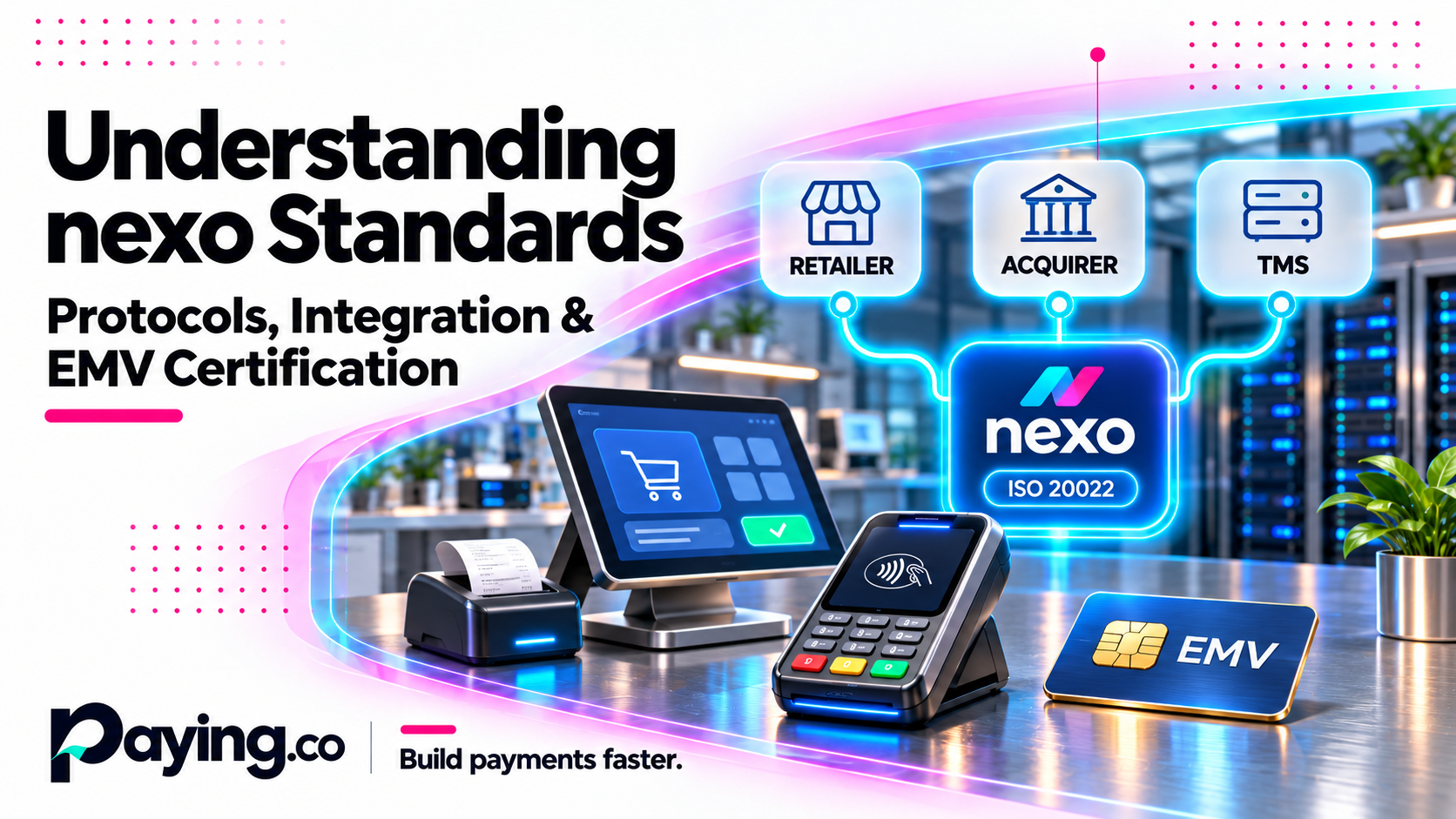
If you build or certify card payment software, you will eventually meet the word nexo. It may arrive in an acquirer specification, a retailer request for proposal, or a European market entry plan. Teams that only know the EMV and card brand side of certification are often surprised by it, because nexo sits in a different layer of the payment stack.
This article explains what nexo standards are, which protocols they define, how they relate to EMV certification, and what to check before a project depends on them.
What nexo is
nexo standards is a not-for-profit association that develops open payment acceptance specifications based on ISO 20022. It was established in 2014 when three earlier bodies merged: EPASOrg, the OSCar consortium, and the CIR SEPA-FAST technical working group. Its membership covers acceptors, processors, schemes, payment service providers, and vendors. The specifications are freely available, and you create a free account to download them.
The goal is interoperability. Instead of every acquirer and every terminal vendor inventing its own message format, nexo defines a common one, so the same terminal application can talk to more than one acquirer and a point of sale system can work with more than one terminal.
The protocols
nexo is a family of protocols, each covering one connection in the acceptance chain.
✦ nexo Acquirer protocol: The interface between an acceptor and an acquirer. It is built on ISO 20022 acceptor-to-acquirer card messages and covers authorization, completion, cancellation, reconciliation, batch transfer, and diagnostics. It supports real-time or batch submission, with a direct connection to the acquirer or through a payment service provider.
✦ nexo TMS protocol: The interface between the terminal and a terminal management system, used for functions such as parameter download.
✦ nexo Retailer protocol: Also called Sale to POI. It defines the interface between a retail sales system and the card payment application on the terminal. Version 3.1 is widely deployed over XML on HTTP or TCP, and later versions are based on the ISO 20022 data dictionary.
✦ nexo security specification: The mechanisms that protect messages across the Acquirer, TMS, and Retailer protocols.
nexo also publishes an ATM protocol, which is outside the scope of this article.
nexo FAST and the implementation specification
Protocols describe messages. A terminal also needs an application that behaves consistently. That is the job of nexo FAST, a common payment application specification for the point of interaction (POI).
The nexo implementation specification (NIS) ties it together. A NIS package describes how a compliant nexo FAST application should work with the Acquirer protocol, the TMS protocol, the security specification, and, optionally, the Retailer protocol. Version 4.0 pairs the Acquirer protocol v6.0 and TMS protocol v6.0 with Retailer protocol v3.1 as optional.
A vendor implementing a nexo FAST terminal has to support, among other things:
✦ A nexo FAST application, version 3.1 or later.
✦ An interface to the Acquirer protocol and another to the TMS protocol.
✦ Connections to at least one acquirer host, with support for a multi-acquirer environment.
✦ A connection to a TMS host for parameter download.
✦ The cryptographic mechanisms in the nexo specifications.
How nexo relates to EMV certification
nexo does not replace EMV. Chip, contactless, and card brand behavior at the terminal still follow EMV and the card brand rules, and an acquirer that requires EMV Level 3 still requires it. nexo standardizes how the terminal application exchanges information with the acquirer, the terminal management system, and the sales system.
In practice that means two separate questions on the same project:
✦ Does the application pass the acquirer and brand certification for the card flows?
✦ Does it speak the required nexo protocols correctly, and has that been validated by an accredited test tool or certification body where one is required?
Treat them as parallel workstreams with separate evidence, separate test tools, and often separate owners.
Who actually needs to care
✦ Terminal and POS vendors selling into markets where acquirers or large retailers require nexo, particularly in Europe.
✦ ISVs integrating a POS host to a gateway that exposes a nexo Acquirer interface. Some large processors publish developer guides for exactly this integration.
✦ Retailers and fuel operators running multi-acquirer estates, who want one terminal application to work across acquirers. TotalEnergies is a published example of certification with NIS v4.0 for POI.
✦ Teams building Sale to POI integrations between a point of sale and a payment terminal.
If your acquirer and market do not mention nexo, you may never need it. If they do, plan for it early.
Testing and certification
nexo-aligned certification uses accredited test tools. nexo has announced an accredited test tool for validating acquirer hosts against Acquirer protocol v6.0, followed by a POI test tool. Test labs have also been authorized to evaluate implementations against the Acquirer protocol v6.0. Because the tools and the accrediting bodies change, confirm the current process with your acquirer and the lab before you plan the schedule.
Where nexo is heading
Recent nexo work includes instant payments at the point of interaction, payment encryption updates, and post-quantum cryptography on the technical roadmap. nexo has also signed an agreement with the European Central Bank related to digital euro payments. If you are building for Europe, those developments may reach your roadmap sooner than you expect.
Questions to answer before you commit
✦ Which nexo protocols does the acquirer or retailer actually require, and which versions?
✦ Is the Retailer protocol in scope, or only the Acquirer and TMS protocols?
✦ Is certification needed, who performs it, and which accredited tool is used?
✦ How will nexo certification be scheduled alongside EMV and brand certification?
✦ Does the terminal need to support more than one acquirer?
✦ Who owns the specifications on your team, given that each protocol has its own versions and change requests?
Where Paying.co fits
Paying.co is a payment engineering firm that specializes in EMV Level 3 certification, payment applications, and acquirer integration. Where a project involves a nexo interface, the same discipline applies as with any certification: confirm the exact specification versions in writing, plan the evidence before testing, and keep the work streams separate.
Planning a project that touches nexo, EMV, or both? Talk to us before the schedule is fixed: paying.co/contact-us or book a meeting with one of our founders at paying.co/meet/kevin.
Sources
nexo implementation specification
nexo Retailer quick starter guide

Software executive with over three decades of experience. Focus primarily on the payment industry and FinTech technologies