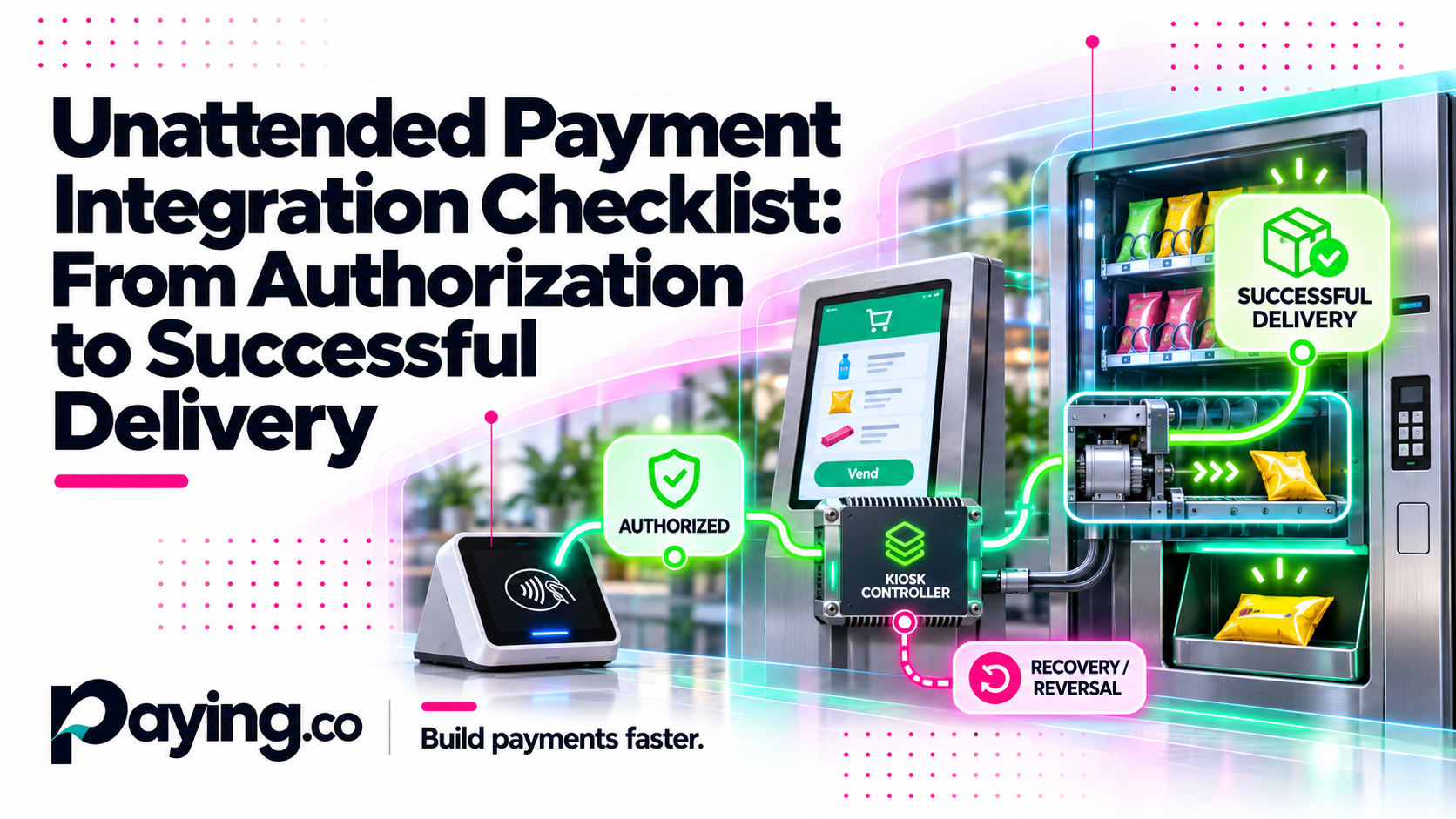
A processor approval proves that a card was accepted. It does not prove that the drink dropped, the wash cycle started, the gate opened, or the charger delivered power. In unattended commerce, the money and the machine are two different systems, and most expensive incidents happen in the gap between them.
Readiness has to cover the whole chain:
Customer → payment device → processor → controller → machine → delivery confirmation → recovery
This checklist is for operators planning a new integration or troubleshooting a deployment in vending, laundry, parking, EV charging, petroleum, car wash, or kiosk environments. It focuses on planning and integration readiness, rather than only monitoring after launch.
1. Payment device and machine controller compatibility
Confirm that the payment device and the controller can actually talk to each other before you choose hardware. Check the electrical interface, the protocol version, and the way the controller expects sessions to start and end. Compatibility on a datasheet is not the same as compatibility on your machine.
2. Interface type: MDB, pulse, serial, API, or proprietary
The interface decides how much information moves between payment and machine.
✦ MDB: A two-way protocol with defined messages for sessions, vend requests, and vend results. It carries enough information to confirm delivery.
✦ Pulse: Typically a simple signal that tells the machine to credit or start. It carries far less information back, so delivery confirmation and recovery need extra thought.
✦ Serial, API, and proprietary interfaces: Flexible, but each one needs documentation, test tools, and a clear owner for the interface specification.
Know which one you have, and what it can and cannot tell you.
3. Authorization versus vend or service confirmation
Decide what event finalizes the charge. A common pattern is to authorize first, then capture only after the machine confirms delivery. Another is to charge on approval and refund on failure. Both can work, but the choice drives your reversal logic, your customer experience, and the amount of money exposed when something fails.
4. Reversals when delivery fails
If the machine does not deliver, the customer should not pay. Define how a failed vend or service is reported to the payment side and how the authorization is released or refunded. Test it deliberately: jam the product, interrupt power, and block the dispense path.
5. Timeouts and intermittent connectivity
Every link in the chain can time out: device to processor, processor response, controller acknowledgement. For each one, define what the system assumes and what it does next. An unknown result should trigger a status check, not an assumption of success or failure.
6. Offline behavior and store-and-forward risks
Decide whether the device may accept payments when connectivity is down. Storing transactions to send later increases availability but moves risk to you, because a transaction approved offline can be declined when it is finally sent. Set limits, document the exposure, and make sure your reporting separates offline transactions from online ones.
7. Duplicate-transaction protection
Retries, repeated button presses, and reconnection can all create a second charge. Use unique transaction references and idempotent handling on both the device and the backend, and test what happens when the same request arrives twice.
8. Refund, retry, and recovery rules
Write down the rules before launch: who can refund, how a customer reports a failed vend, whether the machine may retry delivery, and how a customer is made whole when an operator is not present. Unattended means no attendant to improvise a fix.
9. Remote monitoring, APIs, and webhook events
Payment events and machine events need to land in one place. Plan the data you need: authorization results, vend results, error codes, connectivity state, and machine status. Decide how events are delivered, such as API polling or webhooks, and what happens when an event is delayed or arrives out of order.
10. Device identity and machine-location mapping
Every payment device should be tied to a specific machine and location in your records. Without that mapping, a transaction report cannot tell you which machine misbehaved. Decide how a device is registered, what happens when it is moved or replaced, and who keeps the records correct.
11. Maintenance and support responsibilities
Name who handles what: the operator, the integrator, the processor, the device maker, and the machine manufacturer. When a machine takes money and delivers nothing, the customer does not care whose fault it is, and neither will your support queue unless ownership is clear.
12. Processor, terminal, and regional certification requirements
Some device and processor combinations require certification, and requirements differ by region. Confirm early what applies to your terminal, your processor, and the markets where you will deploy, because certification time can dominate a launch schedule.
13. Evidence required to diagnose production incidents
When a customer disputes a charge, you need proof of what happened. Decide in advance what you capture for each transaction: timestamps, device and machine identifiers, authorization and response codes, the vend or service result, firmware versions, and any connectivity events. Evidence you did not record cannot be recovered later.
Quick readiness check
Before you go live, you should be able to answer yes to each of these:
✔ We know exactly what the interface can and cannot report back.
✔ A failed delivery always results in a released or refunded charge.
✔ We have tested timeouts, power loss, and offline behavior.
✔ Duplicate requests cannot create duplicate charges.
✔ Every device is mapped to a machine and a location.
✔ Support ownership is written down.
✔ We can reconstruct any transaction from the records we keep.
How the pieces connect in practice
Paying.co works across the payment, certification, device, and machine-control layers. Products such as MDB Pay Connect and Pulse Pay Connect show how payment and operational events can be linked, so an approval, a delivery result, and a recovery action can be read as one story rather than three separate logs. The same thinking applies whatever hardware you choose.
Next step
The least expensive time to fix an architecture problem is before hardware is selected. Have Paying.co review your payment-to-machine architecture before you select hardware or begin integration: paying.co/contact-us
To learn more about the products mentioned: MDB Pay Connect and Pulse Pay Connect.
UnattendedPayments #Vending #MDB #PaymentTelemetry #IoT #ConnectedCommerce #PaymentEngineering

Software executive with over three decades of experience. Focus primarily on the payment industry and FinTech technologies